
iBT


iBT — a passive Bluetooth / BLE observer for Sailfish OS
iBT turns a Sailfish OS phone into a strictly passive Bluetooth / BLE security and analysis tool. Using only the phone's own radio (via BlueZ), it listens to the advertising data that nearby devices broadcast anyway and makes sense of it — without ever transmitting, connecting, intercepting, attacking, logging or exporting anything.
Developed and tested on J2 and Xperia10III.
What it does
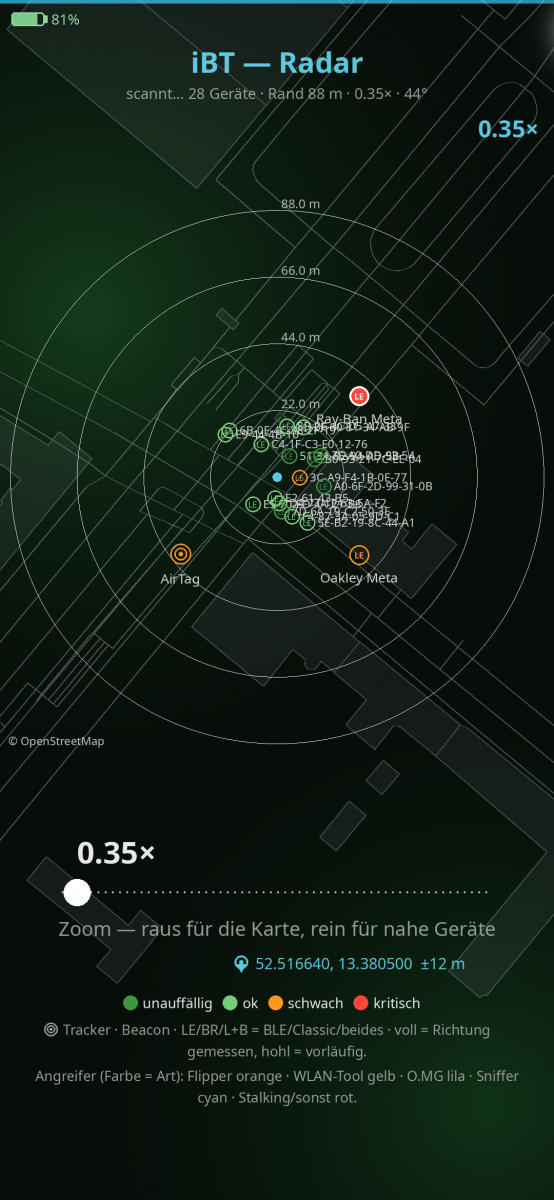
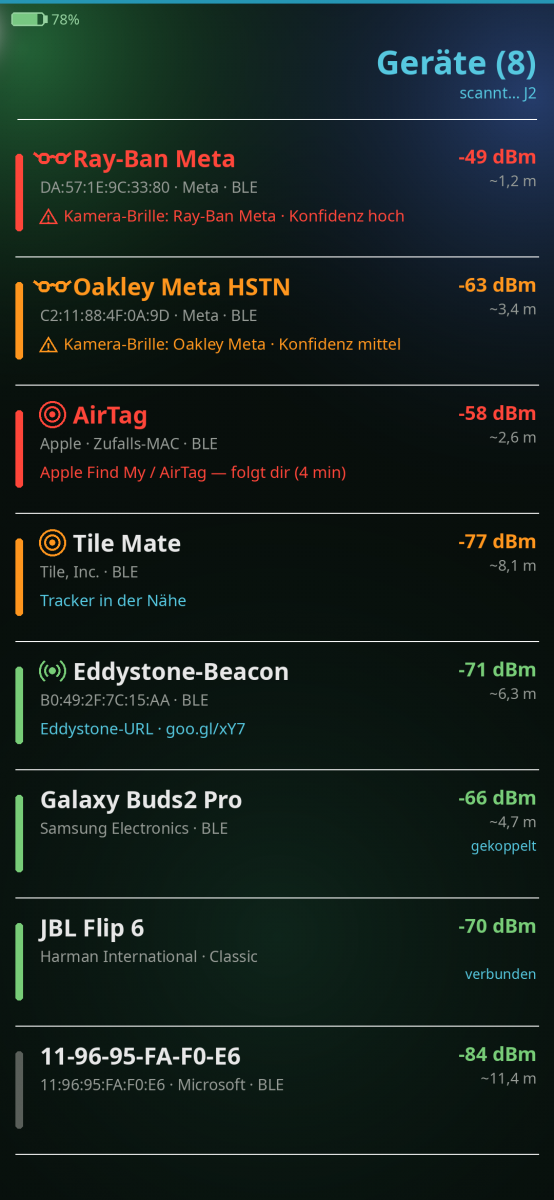
- Live device scan — name, MAC, address type (random/static), RSSI, rough distance, device kind (LE / Classic / dual), advertised services and manufacturer data.Radar view — a heading-up proximity radar of the devices around you, plus a sortable list and a per-device detail page.
- Beacon decoding — iBeacon, Eddystone and AltBeacon.Unwanted-tracker detection — flags AirTag / SmartTag / Tile-style trackers that may be following you.
- Unwanted-tracker detection — flags AirTag / SmartTag / Tile-style trackers that may be following you.
- Camera-glasses alert (“Ruck Zuck”) — flags nearby camera / smart glasses (Meta Ray-Ban, Oakley Meta, Snap Spectacles and the like) right in the scan list from their BLE advertising signature, with a confidence rating. It detects presence only — not whether a camera is actually recording.
- Threat-gadget recognition — passively classifies well-known hostile Bluetooth gadgets by their advertising signature.
- Attack detection — spots advertising-layer BLE-spam / flood activity.
- Vendor fingerprinting — offline OUI → vendor lookup.
- CVE lookup — on request, queries public vulnerability data for a device's vendor / model (egress happens only when you tap it).
- Map view — an optional OpenStreetMap view, used purely to centre on your current position; the location never leaves the device except for the tile request you trigger.
What it deliberately does NOT do
iBT is built to be legally unambiguous and privacy-respecting:
- beyond the ordinary link-layer discovery signal that every Bluetooth scan (including the phone's own system settings) uses to find nearby devices, it sends no information and actively queries nothing — no connection, no GATT, no pairing;
- it never intercepts or decrypts traffic;
- it never attacks, jams or manipulates anything;
- it keeps no logs, performs no data export, and does no background data collection or aggregation;
- the only thing it persists is your own app settings.
Everything it shows — device fields, advertised services, service data and the connection/pairing status — is read locally from the phone's BlueZ interface, never asked of the remote device. It reads what every device freely advertises into the air — nothing more.
Screenshots:
Category:
Application versions:
| Attachment | Size | Date |
|---|---|---|
 harbour-ibt-0.1.3-1.aarch64.rpm harbour-ibt-0.1.3-1.aarch64.rpm | 800.38 KB | 25/09/2026 - 15:41 |
Changelog:
(none)
Comments
carepack
Wed, 2026/09/23 - 16:43
Permalink
Nice. Great tool.
explit
Wed, 2026/09/23 - 02:55
Permalink
Very cool. Such apps make SailfishOS really exclusive OS